



Albert Einstein is once claimed to have said: "Compound interest is the most powerful force in the universe. Compound interest is the eighth wonder of the world. He who understands it, earns it; he who doesn't, pays it."
Considering that Albert Einstein was one smart cookie, let's heed his advice. Once you understand the power of compounding, you can harness it to your advantage. In this article, you'll learn what compounding is, how to calculate it, and what you can do next to turbocharge your savings and share portfolio.

Image source: Getty Images
Understanding compounding
Before we delve into compounding, which is another word for compound interest, let's take a look at simple interest.
Simple interest is calculated on the initial principal. For example, if you have $10,000 in the bank and your simple interest rate is 1%, then the interest earned is $100. Very clear and simple to understand.
Your savings grow steadily, but there's no exponential growth.
However, with compounding interest, your money accumulates faster because you earn interest on top of interest.
To understand this further, let's look at the following graph.
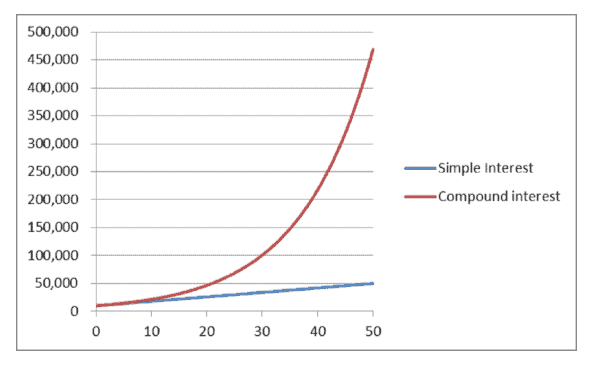
As you can see, the impact of compounding interest effectively supercharges your investment return.
Compound interest doesn't just apply to savings in the bank. It also works on your share portfolio. When people refer to compounding in relation to investments, they're talking about the process whereby investment returns are reinvested to generate additional returns over time.
What to consider when calculating compound interest
To calculate compound interest, we need to use the compound interest formula:
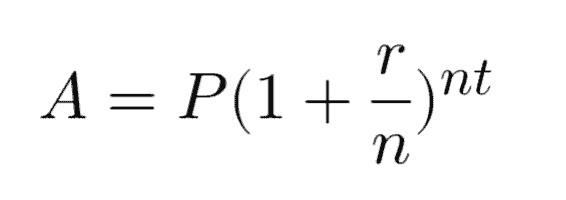
A = Final amount, including principal
P = Principal amount
r = Interest rate
n = Number of times interest is calculated per time period
t = Number of time periods
With compound interest, the future value of your investment grows over time because you earn interest on previous interest payments. To benefit from compounding, you need to reinvest the returns made on your investments. This allows your wealth to grow at an accelerated rate.
The effects of compounding apply equally to investments in ASX shares and cash in the bank. With ASX shares, you can reinvest your dividends and capital gains. With money in the bank, you can bank interest earned on your principal. Therefore, you will earn dividends on your dividends and interest on your interest.
Increased compounding periods/frequency
You only need three inputs to take advantage of compounding — time, money, and earnings. The effects of compounding, however, will vary depending on the specifics of those inputs. The more frequently compounding occurs, the faster your investment will grow.
So, if you have two otherwise identical investments, but one compounds twice as often as the other, the one that compounds more frequently will earn greater returns over the long term. This is because the more frequently earnings are compounded, the more rapidly your principal balance will grow.
Regularly contributing to your principal or share portfolio will also help you grow your wealth over time.
A good rule of thumb is to make regular and consistent contributions and let the wonderful power of compounding work its magic.
Here is an example of how you can increase your wealth if you embrace saving and compounding earlier rather than later.
Let's say you have three people saving at different points in their lives. One person makes an initial investment at age 25, another at age 35, and the other at age 40.
The first two investors save $300 per month, whilst the last investor saves $600 per month to try and catch up for lost time.
Each investor earns an annual interest rate of 5%.
If we compare the results of all three investors when they reach age 65, we can see how investing early and taking advantage of compound interest pays off.
- Investor 1, who started saving at age 25, ends up with $460,000
- Investor 2, who started saving at age 35, ends up with $251,000
- Investor 3, who started saving at age 40, ends up with $180,000, despite investing more money.
Simple vs. compound interest
There is a major difference between simple and compound interest. With simple interest, your interest earned does not compound and is calculated solely on your principal amount.
As for compound interest, it's calculated on the principal amount and previous interest payments, so you end up earning interest on interest.
Here's an example of simple interest over 20 years with an 8% return.
| Year | Balance | Annual interest | Total value |
| Year 1 | $10,000 | $800 | $10,800 |
| Year 2 | $10,000 | $800 | $11,600 |
| Year 3 | $10,000 | $800 | $12,400 |
| Year 4 | $10,000 | $800 | $13,200 |
| Year 5 | $10,000 | $800 | $14,000 |
| Year 10 | $10,000 | $800 | $18,000 |
| Year 20 | $10,000 | $800 | $26,000 |
That's $26,000 total value across 20 years.
Now, with compounding interest, you earn interest on your initial deposit and every interest payment made on top of it.
Here's how compound interest plays out over 20 years at an 8% interest rate.
| Year | Balance | Annual interest | Total value |
| Year 1 | $10,000 | $800 | $10,800 |
| Year 2 | $10,800 | $864 | $11,664 |
| Year 3 | $11,664 | $933.12 | $12,597.12 |
| Year 4 | $12,597.12 | $1,007.77 | $13,604.89 |
| Year 5 | $13,604.89 | $1088.39 | $14,693.28 |
| Year 10 | $19,990.05 | $1599.20 | $21,589.25 |
| Year 20 | $43,157.01 | $3,452.56 | $46,609.57 |
That's more than an extra $20,000 additional value just by taking the interest and reinvesting it.
As you can see, thanks to continuous compounding, your money snowballs. Of course, the big lesson here is that the earlier you start, the better. This means you will reap the benefits of compounded interest over a longer period. If you start later on in life, you'll need to save more money to catch up to early savers.
Why is compounding essential?
Compounding plays a pivotal role in growing your wealth. It won't grow if you decide to keep your money under the mattress. But if you invest your money and let the power of compounding work for you, it can grow exponentially over time.
Warren Buffett made most of his wealth later in life, thanks in no small part to the effect of compounding on his investments. The investment icon turned a net worth of $1 million at age 30 into $1 billion by the age of 56. He is now worth some $70 billion.
"My wealth has come from a combination of living in America, some lucky genes, and compound interest," Buffett said.
Get started with compounding your wealth
If you would like to play around with some numbers and understand the power of compounding, you can do so using this compound interest calculator1.
Simply enter the initial principal, monthly contributions, and interest rate, and the calculator will automatically calculate the numbers for you.
Remember: The sooner you get the magic of compounding working for you, the sooner you'll be able to turbocharge your wealth.
How does compounding work with shares?
The effects of compounding work in a similar way for share portfolios as they do for money in the bank. The key is to reinvest your investment earnings.
ASX shares generate earnings in the form of dividends and capital gains. If you reinvest these earnings in more shares, you can earn more dividends and make more capital gains.
These can be reinvested to earn more again! Not only are you making earnings on your initial investment, but you are also making earnings on your earnings. Compound returns effectively put your money to work for you. This can result in your wealth rapidly snowballing.
The longer you leave your investments to compound, the greater the effects will be. Time is the magic ingredient in the compounding formula.
An investment left untouched for decades can add up to a sizeable sum, even if you never add another dollar. That's what makes compounding so powerful and how it can help you exponentially grow your wealth.
[KevelPitch adtype=151]